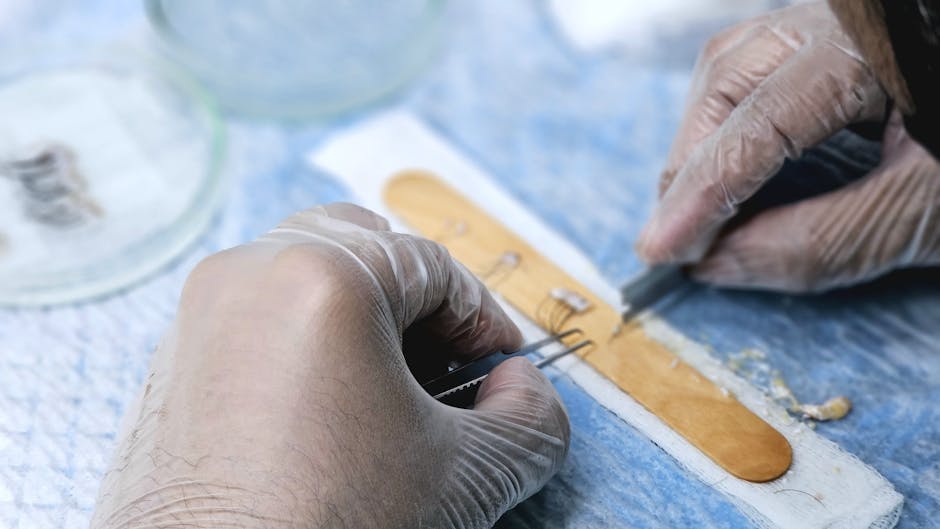
Hair transplant surgery moves hair follicles from the back and sides of the scalp, where follicles are resistant to DHT, to areas of thinning or balding. The two techniques differ in how donor follicles are harvested: follicular unit extraction (FUE) removes individual follicular units one by one using small punch tools, while follicular unit transplantation (FUT) removes a strip of scalp tissue from the donor area and then dissects individual follicular units from it under a microscope. Both techniques place harvested follicles into small incisions in the recipient area using the same approach.
The choice between FUE and FUT depends on factors specific to the patient: how many grafts are needed, whether the patient will wear their hair very short, scarring tolerance, and the surgeon’s skill with each technique.
Follicular Unit Transplantation (FUT)
FUT, also called the strip method, involves surgically removing a horizontal strip of scalp tissue from the donor area (typically the occipital region at the back of the head). The wound is closed with sutures, leaving a linear scar that heals to a fine line, usually well-hidden when hair is worn at moderate length.
The strip is then processed in a laboratory under magnification, technicians dissect it into individual follicular units containing 1-4 hairs each. These units are then implanted into the recipient area.
Advantages of FUT:
- Yields a larger number of grafts from a single session than FUE, important for patients with extensive hair loss requiring 3,000+ grafts
- Follicular units remain intact during extraction, producing slightly higher graft survival rates in some comparisons
- Lower cost per graft in most practices
Disadvantages of FUT:
- Linear scar at the donor site, visible if the patient chooses to shave the back of the head
- Longer recovery time at the donor site (suture removal at 10-14 days)
- Donor site discomfort and tightness during healing
Follicular Unit Extraction (FUE)
FUE uses small circular punch tools (0.7-1.0 mm diameter) to individually extract follicular units directly from the scalp. Each punch creates a small round wound that heals to a tiny dot scar, rather than a linear scar. When many punch sites are distributed across the donor area, the scarring is diffuse and not visible at most hair lengths.
Because no strip is removed, the procedure requires no sutures and has a shorter recovery time in the donor area, most patients are comfortable within days rather than weeks.
Advantages of FUE:
- No linear scar, suitable for patients who wear hair very short or shaved
- Faster donor site recovery
- Can harvest grafts from body hair in some cases (beard, chest) for patients with limited scalp donor supply
Disadvantages of FUE:
- More time-consuming per graft, large sessions require longer operative time or multiple sessions
- Slightly higher graft transection rate (damage to follicles during extraction) in less experienced hands
- Higher cost per graft than FUT in most practices
Graft Survival: What the Evidence Shows
Graft survival depends more on surgical technique and post-operative care than on the harvesting method per se. A review published in the Journal of the American Academy of Dermatology found that graft survival rates of 85-95% are achievable with both techniques when performed by experienced surgeons following proper ischemia-minimizing protocols.
The most critical variable is minimizing the time between extraction and implantation, follicles survive poorly outside the body and must be implanted within a few hours. Both FUE and FUT practitioners maintain this requirement; the technique itself is not the bottleneck.
Who Is a Good Candidate for Hair Transplant Surgery?
Hair transplant surgery is most effective for:
- Men at Norwood Stage 3-5 with stable hair loss (not actively progressing rapidly)
- Men with sufficient donor hair density in the occipital region
- Men on medical therapy (finasteride or minoxidil) to prevent progression in non-transplanted areas
Less suitable for:
- Men with actively progressing hair loss who are not on medical therapy, transplanted follicles are permanent, but untreated native hair will continue miniaturizing
- Men with diffuse hair loss affecting the donor area as well as the recipient area
- Very young men (under 25) whose final hair loss pattern is not yet established
The most common mistake in hair transplant surgery is operating on young patients before the hair loss pattern is stable, resulting in transplanted hair that eventually looks out of place as surrounding native hair continues to thin.
Combining Surgery With Medical Therapy
Most hair transplant surgeons recommend ongoing medical therapy, finasteride, minoxidil, or both, alongside surgery. The transplant addresses existing bald areas, but medical therapy slows progression of native hair loss in areas adjacent to the transplant. Without medical therapy, transplanted hair sits in a field of progressively thinning native hair, and the cosmetic result deteriorates over time.
For the medical treatment options at each Norwood stage before considering surgery, see The 7 Stages of Male Pattern Baldness Explained. For the finasteride side effect evidence that informs that decision, see Finasteride Side Effects: What the Research Actually Shows.